You’ve had a go with an AI exhibition stand design tool.
You’ve typed in a few prompts about your brand and your industry, and out popped an image that stopped you in your tracks.
Bold structure, striking colours, your logo sitting proudly on a wall that looks like something from a design magazine. It’s exciting, and it should be. That excitement is exactly what a good concept is meant to spark.
But there’s a question many people don’t think to ask at this point: what needs to happen between that image on your screen and a stand you can walk onto at the NEC or ExCeL?
The honest answer is quite a lot, and most of it never shows up in the concept the AI tool has created for you. This blog walks you through that journey, step by step, so you know what to expect if you’re holding an AI concept of your exhibition stand and wondering what happens next.
The AI concept stage
At this point, what you’ve got is a visual direction for your exhibition stand. It might give you a rough sense of scale, a colour palette that feels right for your brand, maybe some structural ideas like curved walls or a raised platform. It’s a useful starting point, and for stakeholders who struggle to picture things from a written brief, it can be worth its weight in gold when it comes to getting internal buy-in.
What it isn’t, though, is a plan. There’s no information here about your stand’s footprint, your budget, the show you’re exhibiting at or what your stand needs to do once people are standing in front of it. Think of this stage as the spark of an idea rather than the idea itself. It tells you what you like the look of. It doesn’t tell you how to get there.
Turning your AI design concept into a brief
This is where the real work starts, and it’s also where many people underestimate what’s involved. Your concept image needs to become a proper brief before anyone can build anything from it, and that means answering questions the AI tool never asked you.
What’s your stand footprint? Is it a shell scheme space, a space-only site, or an island position? What’s your budget, realistically, once you’ve factored in the build, graphics, technology, storage and on-site staffing?
What does your stand need to do functionally, beyond looking good? Do you need a demo area, a private meeting space, product storage, a bar or refreshment point?
An experienced creative design agency like Exhibit Interactive will ask these questions early, because the answers shape everything that follows. Skip this stage, or rush it, and you’ll risk falling in love with a look that has no relationship to what you can afford or fit into your space.
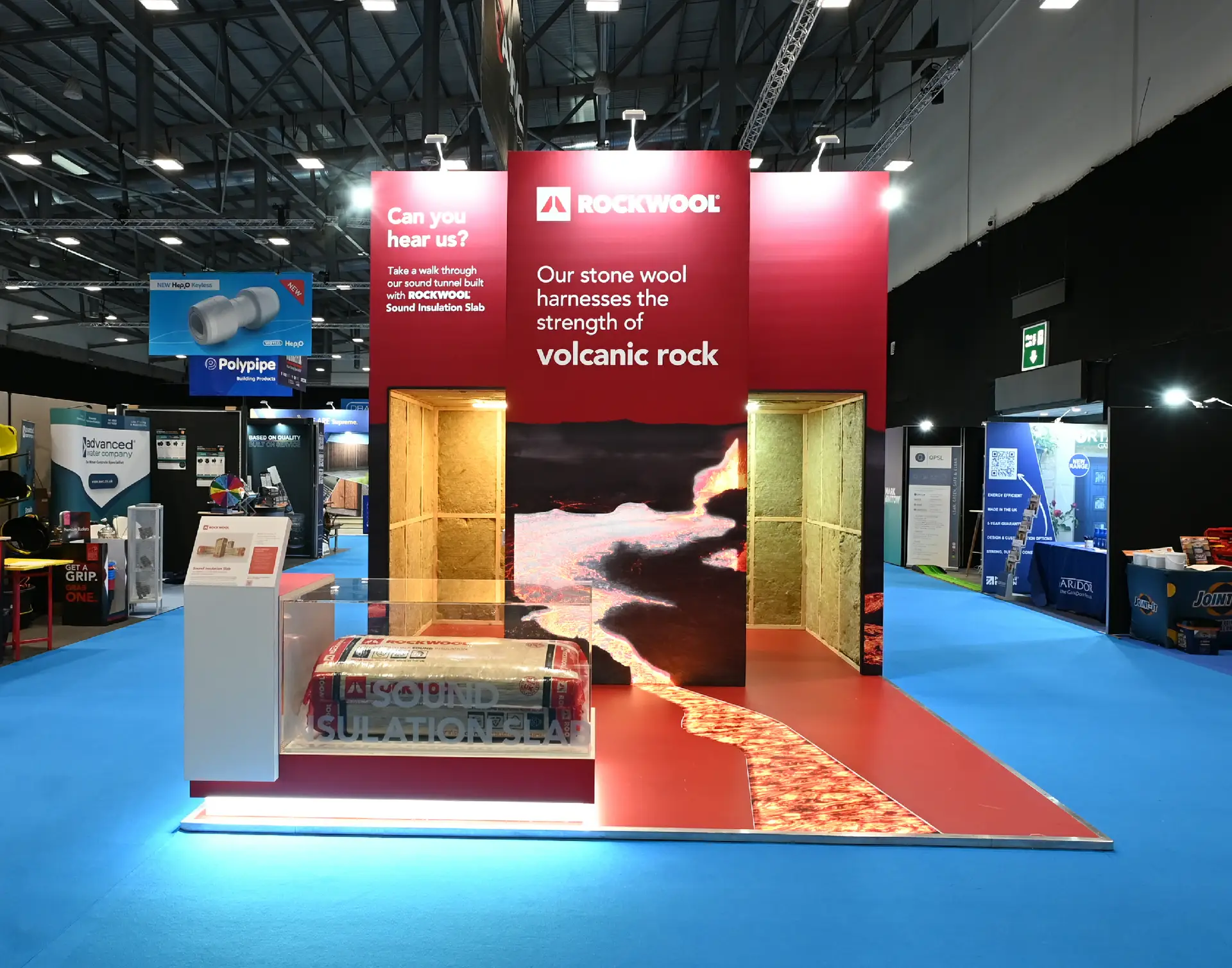
The technical reality check
Once there’s a proper brief in place, the next stage is putting the AI concept through a technical review. This is where an experienced team looks past the surface appeal of the design and asks whether it can genuinely exist in the real world.
Venues have their own rules, and they vary hugely from show to show. Height restrictions, rigging points, loading bay dimensions, fire exit clearances and sightline requirements all need checking against the concept.
Materials matter, too. Some finishes that look striking in an AI render are hard to achieve in the real world, or might not be fire-rated for indoor use.
So, this stage isn’t about knocking your idea down. It’s about finding out which parts of the concept can survive contact with reality as they are, and which parts need adapting.
Sometimes that means a slight change to a structure’s height. Sometimes it means swapping a material for something that achieves a similar look but works on site. Either way, this is the point where an idea either holds up or gets refined into something that will.
Design development
With the technical questions answered, the design moves into development. This step is where technical drawings replace renders, and where every element of the stand gets specified in detail, including materials, finishes, lighting, graphics, and on-stand furniture and interactive technology.
Good design doesn’t throw away what made the original AI concept appealing. The aim is to keep the spirit of that idea while making it buildable, which is a creative process in its own right.
It also involves working out the build schedule, so everyone knows what gets made in the workshop, what gets fitted on site, and in what order.
None of this appears in an AI concept image, because none of it is visual. It’s the practical scaffolding that turns a good-looking idea into a workable exhibition stand.

Build and installation
From here, the project moves into production. With modular stand systems like t3 or beMatrix, much of the stand can be prefabricated in a workshop, then transported to the venue and assembled on site. That means less mess and waste, quicker installation and a stand that’s been tested and checked before it ever reaches the exhibition hall.
This stage takes coordination that no AI tool can plan for, such as booking build slots within tight venue schedules, managing deliveries, briefing on-site teams and having contingencies ready if something needs adjusting at the last minute. It’s the physical, hands-on stage of the journey, and it’s where all the earlier planning either pays off or falls apart.
This is also where experience counts more than anything else. At ei, our team has installed and taken down hundreds of stands at venues across the UK, Europe and beyond.
We’ve seen most of what can go wrong, from delayed loading bay slots to last-minute changes in venue regulations, and we know how to solve these problems quickly.
We also understand the quirks of specific venues, from how early you can realistically start the build at the NEC to which ExCeL loading docks cause bottlenecks at peak times. That familiarity means a smoother install, a calmer takedown, and far fewer surprises on the day.
How can Exhibit Interactive help?
If you’ve got an AI concept of your exhibition stand that you’re excited about, that’s a great place to start. What you need next is a team who can take that spark of an idea and walk it through every stage between here and a finished stand.
That’s where we come in. We’re used to picking up ideas at this stage, working out what’s achievable, and shaping them into stands that do their job on the show floor.
We’ll help you achieve a proper brief, a technical review, thoughtful design development and a build that happens on time and on budget.
We’ve worked across a huge range of sectors and venues, from national exhibitions at the NEC and ExCeL to bespoke events for global brands. So, whatever your industry or audience, we’ve likely faced similar challenges before and know how to solve them.
Our team handles everything under one roof, from initial design through to workshop build and on-site installation, which means fewer handovers, fewer things falling through the cracks, and one point of contact throughout. We also bring a genuine creative eye to the process, not just technical know-how, so your finished stand keeps the impact of your original idea rather than losing it along the way. The result is a stand that’s built properly, on schedule, and ready to make an impression from the moment doors open.
So, if you’ve got a design concept you’d like to talk through, get in touch and let’s work out what happens next together.