
If your brand or business wants to reach new markets, exhibiting overseas can be the perfect way to broaden your horizons.
However, the events space has changed so much over the past few years that even the most seasoned global exhibitors can find it challenging to navigate.
Advances in technology, changing legislation, and a global pandemic – not to mention the small matter of Brexit – have all made exhibiting overseas more challenging than it used to be.
But, with the right support and some careful planning and preparation, you can make your overseas event a success. Here’s how…
Benefits of exhibiting internationally
Thanks to the growth in digital technology, the world is getting more connected. It’s now possible for even the smallest brands and businesses to reach an international audience.
However, while the internet has given rise to almost limitless opportunities to grow a business on a global scale, having a local presence in the countries you operate is sometimes necessary. That’s where international events and exhibitions come in.
Exhibiting overseas is a great way to expand your company’s reach and make new connections with potential customers. It provides an ideal platform to have your products or services seen by the largest possible audience. It allows you to showcase your brand and gives you access to a vast network of international buyers who can help put your business on the map.
International events are a great way to explore new markets and ‘test the waters’ with whatever it is you have to offer. They also provide amazing opportunities for networking, so you can meet potential partners face-to-face.
Exhibiting internationally is an excellent strategy for expanding your market reach and improving your company’s visibility on a global scale.

How to exhibit internationally
International trade shows are a great way of exhibiting your company and products to a global audience. However, there’s no one-size-fits-all answer when it comes to exhibiting internationally.
The first step is finding out which trade shows or events might be relevant for you. So, it’s a good idea to start by looking at exhibitions in your industry. Don’t be afraid to broaden your horizons and explore these exciting opportunities.
You’ll need to consider factors such as where your target market is, what type of products or services you sell and what industry you are in.
Once you’ve decided on your show and booked your stand space, here are some things you need to do to ensure the event is a success.
Understand the market
Once you’ve decided on the show, whether it’s in the US, Far East, EU or elsewhere, it’s crucial to gain insight into the destination in question. Rules and regulations, language, local customs and business traditions will all differ to how things are done in the UK, so understanding the differences and how they like to do business is crucial.
English is a widely used language worldwide, especially in business, but you should consider potential language barriers before creating your stand design and marketing materials. You may wish to consider using a translator on your stand to avoid any potential communication issues.
It’s also worth bearing in mind that while we’re free of COVID restrictions here in the UK, that may not be the case in other destinations. So, do your homework beforehand to ensure you’re aware of – and prepared for – any specific health & safety rules. An experienced events partner like Exhibit Interactive can help you research the market beforehand to ensure everything goes off without a hitch.
And depending on the country and type of event, you may also be eligible for Government support to help you exhibit or attend. Check out the Department for International Trade’s UK Tradeshow Programme guidance for more information.
Get the right paperwork
While events tend to run similarly wherever in the world you are exhibiting, there are some key differences you need to be aware of. Regulations governing events differ from country to country, so understanding the local rules in your destination is vital.
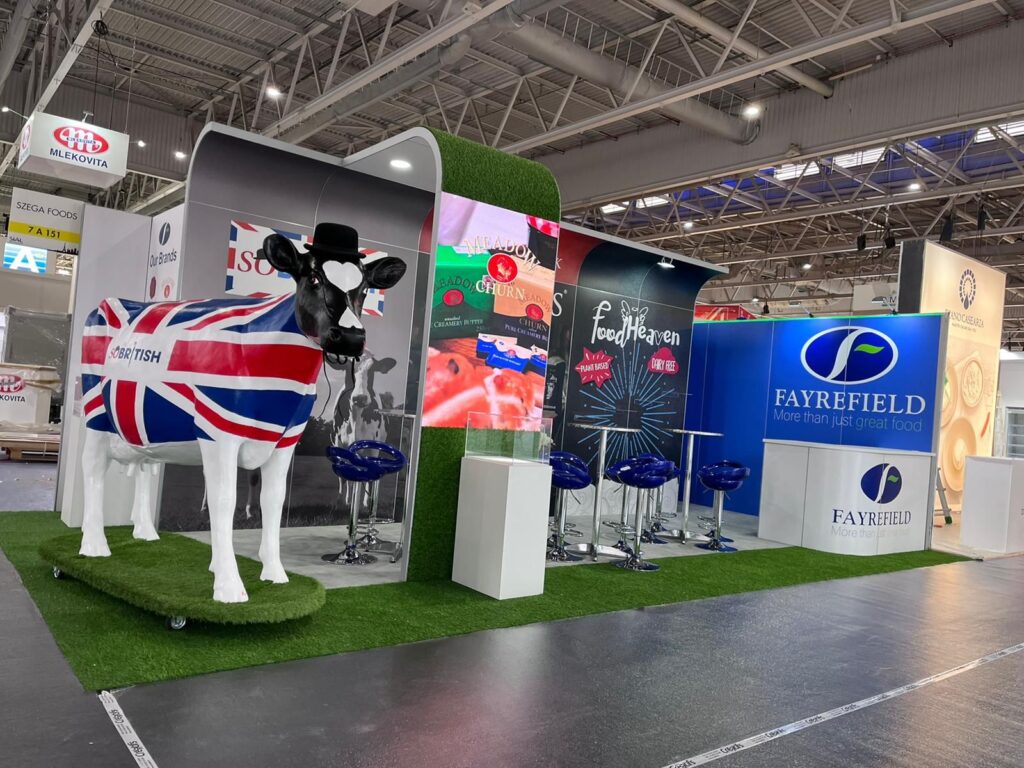
As you’d imagine, it’s more difficult for UK companies to exhibit within the EU post-Brexit. There are tighter rules and regulations around imports and exports. This may affect your exhibition stand if it’s being built in the UK and then shipped to another country for the event. You’ll probably need documentation to get your stand into – and out of – EU countries.
If you’re sending installers on an on-stand team from the UK, there may also be restrictions around visas and work permits. So, ensuring you have all the necessary paperwork, like certificates, licenses, safety equipment, insurance and other legal requirements, is essential.
Customs can be an in-depth and time-consuming process. You may need to submit exhibition plans and other documentation to the event organiser to demonstrate that it meets local fire, electrical and health & safety regulations.
This is where an experienced events partner is worth their weight in gold, to guide you through the process and ensure everything is in place.
Think about logistics
Event logistics play a big part in exhibiting overseas.
Lead times tend to be longer, and stand requirements for things like power vary from country to country. For example, electrical regulations differ across the world. Japan uses 110v electricity while the US uses 120v. In China, Russia and many EU countries, it’s 220v. So, using the correct transformers, adapters and plugs is vital.
Getting your stand to the event can also create a massive logistical headache. If your stand is being shipped by air, for example, is it packed securely, so the individual components don’t get damaged in transit? There’s nothing worse than investing extended time, effort and expense into exhibiting abroad if you turn up to the event and your stand is broken.
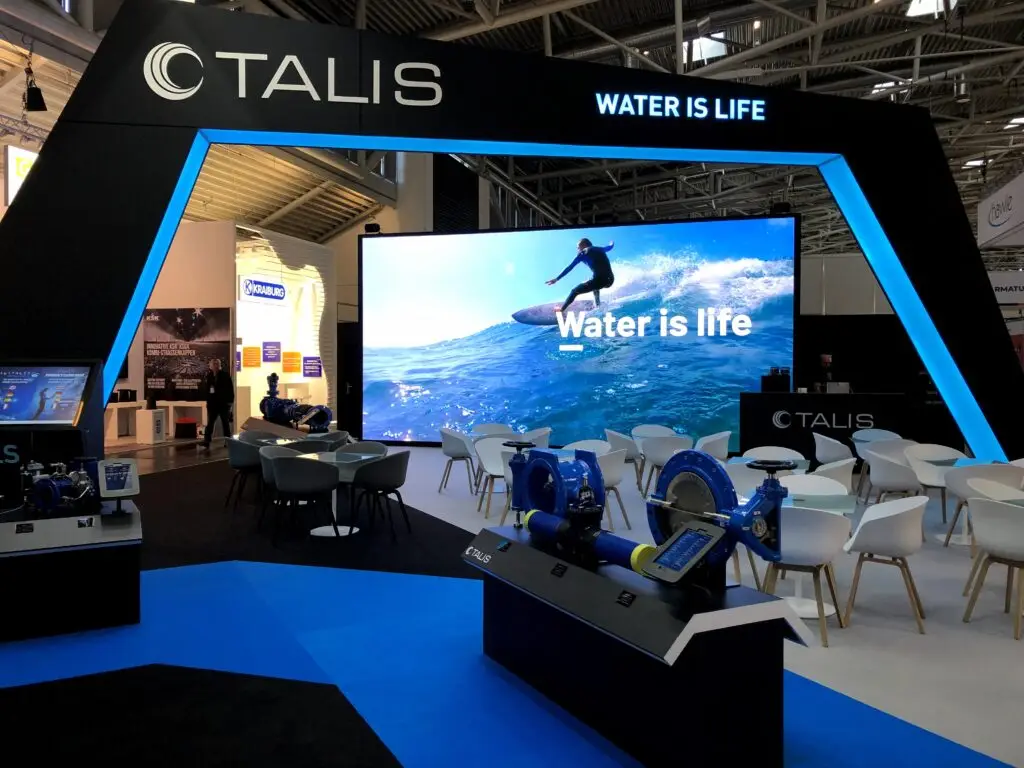
There are a few potential solutions here. You can have your stand designed and created in the UK, then shipped to the venue for local installers to build – check out our Talis case study, where we used this method. This is better suited to short-haul events, such as in the EU. You could even fly out your own installation team with the stand to oversee things – we’ve arranged that for clients, too!
Or, you can get your stand designed in the UK, then built and installed by a local partner. This can be more cost-effective for events further afield, such as in the US, where shipping and transport costs are higher.
However, remember that materials, taxes and other charges may apply if you’re getting a stand built by an overseas contractor. So, do your homework to ensure you don’t get hit by any unexpected costs. Again, your events partner can advise on the best ways to get your stand built on-time and on-budget.
How can Exhibit Interactive help?
If you’re planning on exhibiting abroad, Exhibit Interactive can help take care of all the practical, cultural and logistical issues involved to make your overseas event a success.
We have vast experience of helping UK brands make an impact at international events and can advise you on the best – and most cost-effective – ways to make your ideas a reality.
We can design and create your stand – whether it’s system or bespoke – using sustainable materials to create less waste. And we can take care of everything else, from paperwork, transportation and logistics to installation and removal, so you don’t have to worry about a thing.
To find out more, drop us a line at hello@exhibitinteractive.co.uk.
